Zelda 2 - The Adventure of Link on NES (mini) and GBA (NES classic): principles and tips (tutorial)

Principles
As I said in my introduction, Zelda II is the only A-RPG in the Zelda series. Like in quite a few RPGs, the hero, Link, will roam a large world map (Hyrule) without being able to strike freely as was the case in Zelda 1.
On this map, however, Link will encounter enemies that will either be small ( )
or large (
)
or large ( ). This is where the "A" in "A-RPG" comes in. Indeed, unlike a pure RPG, the fight against the encountered monster will not take place using menus or other types of choices, but will instead be followed by a side-view action phase featuring all kinds of enemies. These enemies will be more or less dangerous depending on whether you encountered the large or small monster and where you meet it. Note that if you are on the road when Link and the villain touch, no combat will take place because the horizontal phase will not contain any monsters.
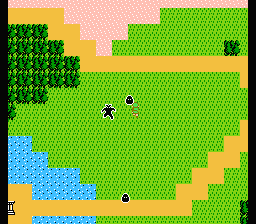
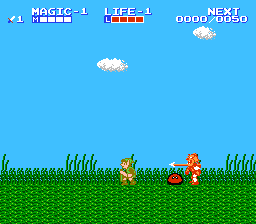
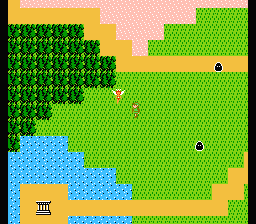
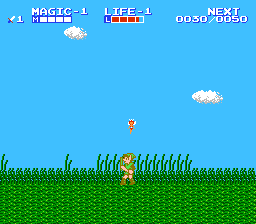
You will sometimes see fairies instead of monsters; if you touch them, you will enter an action phase with just a fairy.
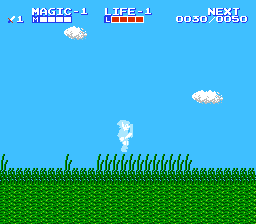
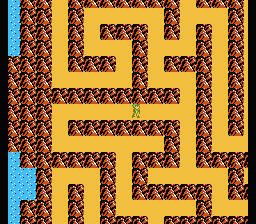
Some squares of the game feature an action phase. Some are fixed, like combats, and you can exit indifferently to the right or left (Link will arrive in the action phase in the middle of it). Generally, these zones contain an item (bag, potion, container, fairy).
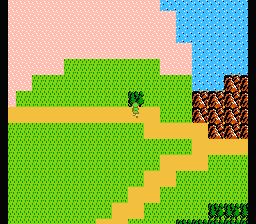
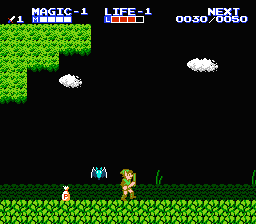
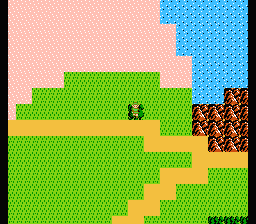
Others allow you to cross a place (a piece of road or a bridge for example) and Link will enter from one side to exit through the other. Apart from bridges, if Link arrives on the square in question at the same time as a monster, only the action phase against the monster will take place.
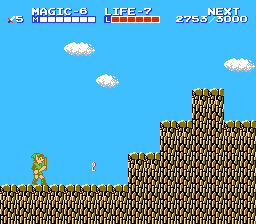
We have talked a lot about action since a moment ago, but A-RPG is also RPG (role playing game) and who says RPG says experience. At the beginning of his quest, Link is far from the overpowered hero who will save Zelda at the end, and the slightest lowder will require 2 sword strikes because he lacks experience. Experience (or XP) is the small number that flies away when you kill an enemy or take a bag; you can see Link's current experience at the top of the screen when you are in an action phase. At the top right, there are 2 numbers, the first is Link's current experience and the second is the next "threshold". When Link reaches this threshold, he is offered to upgrade the characteristic corresponding to that threshold. If he accepts, this characteristic will increase by 1 and Link's current experience will reset to zero. If he refuses, the next threshold will be indicated at the top right and Link's XP will continue to increase (you cannot refuse 3 times in a row). You can see your current characteristics to the left of your experience, the number next to the sword indicates attack power (number of hits reduced to kill an enemy), the number next to "magic" indicates the magic level (the cost of each spell decreases when this level increases) and the number next to "life" indicates Link's resistance (he will lose less life for the same attack from the same enemy if this characteristic increases). If you choose "Life" or "Magic", the corresponding gauge will be filled. Do not confuse this number with your life and magic bar which increases when you find a heart or magic container, these containers are hidden across Hyrule and you can find them easily by visiting the container section. You can see below the level table which indicates for each characteristic how many experience points are required. Do not forget that placing a stone on the statue at the end of a palace will raise your experience up to the next threshold.
 |
 |
 |
|
| 2 | 50 | 100 | 200 |
| 3 | 150 | 300 | 500 |
| 4 | 400 | 700 | 1000 |
| 5 | 800 | 1200 | 2000 |
| 6 | 1500 | 2200 | 3000 |
| 7 | 2500 | 3500 | 5000 |
| 8 | 4000 | 6000 | 8000 |
I also talked about magic but not really about the shape of it. You know that you have a magic bar and a level, but not how the spells are presented. Spells are obtained in villages. In each village, an old man will teach you a spell. Often, you will have to bring something to the mistress of the house so she opens her door for you. Then, the magic menu is accessible via the start menu. There, you select the spell in the list and press start again. This just has the effect of preparing the spell which will then be cast by pressing select. The same spell cannot be cast twice in a row by pressing select twice. To cast life twice in a row for example, you will have to press start twice after the first use. A complete white magic square corresponds to 16 magic points in the magic menu (start).
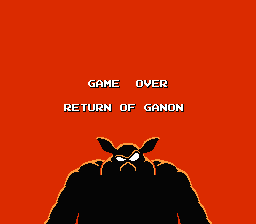
To finish, do not forget that if you lose all your lives, you keep your characteristics but not your current experience, so do not take too many risks by skipping thresholds when it is your last life and lava surrounds you. Remember that if you lose, Ganon will return to Hyrule.
Tips
A few small tips, sometimes obvious, sometimes less so, that will allow you to progress a little more easily in this game which is not known for its ease.
Red potions
Sometimes you will encounter red potions restoring all your magic. It will often happen that you want to use life with this potion. In this case, you must use life while your magical energy is going back up (just after taking the potion so do not forget to "prepare" life). I explain why (warning: elementary school math is going to follow, you can skip to the rest if you don't like it). Let's assume you have 3 filled magic squares (48 points) out of the 5 you have (80 points) and that the life spell costs 50 points at your level. If you take the red potion, it will try to add 80 points to you but it will stop taking effect if the gauge reaches its maximum. So if you let it go and use life after everything is filled, you will have 30 magic points left. If on the other hand you use life while the gauge is rising, the red potion will indeed give you back 80 pts because it will reach 80 before the gauge is filled (48-50+80=78). In this rather classic example, you save 48 magic points (and shame on me if I made a mistake).
Extra life
If Link reaches 9,000 xp points, he will gain an extra life by choosing to increase a characteristic that is already at maximum (level 8).
Avoiding an action square
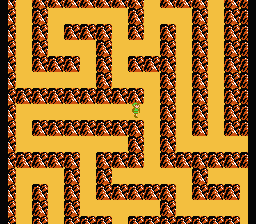
A square with an action phase seems hard to cross? Wait for enemies and go to the square in question at the same time as an enemy. A "standard" combat will replace the crossing of the square. This cannot be used everywhere because you need terrain with possible combat nearby for enemies to arrive (not like in the Northeast labyrinth for example). This trick does not work for bridges either.
Avoid falling into lava
In palaces, Link will often be confronted with some dangerous passages featuring jumps over lakes of lava and enemies ready to push him in. In this kind of passage, I advise you to "prepare" the "fairy" magic and quickly press select if you start to fall.
Optimize the statues at the end of palaces
If after defeating the boss you only lack very little experience, I advise you not to seal the palace. Go back out through the right and return to the palace. Head directly to the boss room while killing a few enemies on your way to gain a level. Then go seal the palace with your crystal to gain another level. If you have left enemies alive, you can also head back to the boss side and go kill them. If you really lack very little XP you can also kill certain small enemies that come back indefinitely (the bots of drippers or wolfheads for example).
Starting palaces well
In most palaces, the starting statue can give you a red potion. So fill up your life there (if you have life). Once your life and magic gauge are full, go out one last time and re-enter so that this potion is accessible if you need it during the course of the palace.
To go further, here is an English page full of info.
Perfectdams & Dark Alucard translated by Gemini
| Back to Zelda II - The Adventure Of Link homepage |
| Back to Nes home |
- Français -- العربية -- বাংলা -- Deutsch -- English -- Español -- हिंदी -- Italiano -- 日本語 -- 한국어 -- Português -- Русский -- 中文 -